
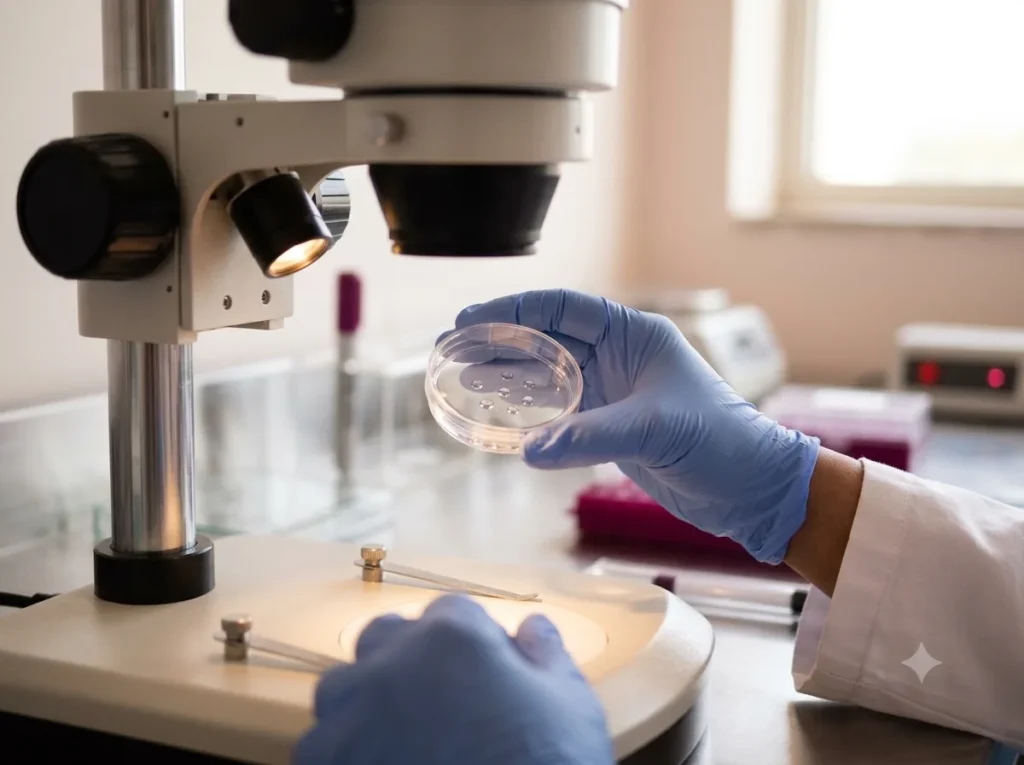
In vitro maturation (IVM) is a fertility treatment in which immature eggs are collected from the ovaries and matured in the laboratory, instead of using high doses of hormones to mature them inside the body as in standard IVF.
What is IVM?
In standard IVF, daily hormone injections stimulate the ovaries for around 8 to 14 days so that several eggs mature before collection. In IVM, eggs are collected while still immature, usually with little or no hormone stimulation. Some protocols use a short course of hormones or a single trigger injection. See IVM (in vitro maturation of oocytes).
How does IVM work?
- Ultrasound scans monitor the ovaries early in the cycle
- Immature eggs are collected from small follicles in a short procedure
- In the laboratory, the eggs are matured for about 24 to 48 hours
- Mature eggs are fertilised, usually by ICSI
- Embryos are grown and one is transferred, or frozen for later
Who may benefit from IVM?
- Women with PCOS who have many follicles and a high risk of ovarian hyperstimulation syndrome (OHSS) with standard stimulation. See PCOS and fertility
- Women who need fertility preservation urgently, for example before cancer treatment. See fertility preservation
- Women who cannot take, or wish to avoid, high doses of hormones
Advantages
- Fewer or no hormone injections
- Much lower risk of OHSS
- Shorter treatment and fewer clinic visits
- Lower medicine costs
Limitations
- Fewer eggs may mature in the laboratory
- Pregnancy rates per cycle are generally lower than with standard IVF in many groups
- IVM requires specialised laboratory expertise and is not offered everywhere
Your doctor can explain whether IVM or standard IVF is more suitable for you.
Frequently asked questions
Does IVM use any hormones?
IVM uses little or no hormone stimulation. Some protocols use a short course of hormones or a single trigger injection.
Is IVM better than IVF?
Neither is better for everyone. IVM can suit women with PCOS or a high OHSS risk, while standard IVF usually gives more mature eggs per cycle.
Are babies born after IVM healthy?
Studies so far suggest that babies born after IVM are as healthy as those born after standard IVF, although research continues.
If you have questions about your own situation, you can meet our doctors at our Basavanagudi, Koramangala and Ballari centres, or contact us to book an appointment.
This article is for general information and does not replace medical advice. Treatment decisions should be made with a qualified doctor who knows your history.